
Summer is peak season for Step 2 CK, and most dedicated study plans are built around the big clinical disciplines: internal medicine, surgery, pediatrics, obstetrics and gynecology, psychiatry, and neurology. Biostatistics and ethics often get squeezed into the last few days.
That's a missed opportunity. These topics appear throughout the exam, the concepts are finite, and the questions are unusually predictable. A few focused hours can turn them into some of the most reliable points on your score report.
First, a Note on the New Format
Step 2 CK moved to updated test delivery software on May 7, 2026. If you test on or after that date:
- The exam is divided into sixteen 30-minute blocks, with no more than 20 questions per block.
- It's still administered in one nine-hour testing session, with at least 55 minutes of break time.
- The content, the total number of questions, and the overall length of the exam day haven't changed.
The pace works out the same as before, about 90 seconds per question, but shorter blocks change the rhythm of the day. Practice in 20-question timed sets so the new block length feels natural. And remember that Step 2 CK is scored; the minimum passing score has been 218 since July 1, 2025.
Biostatistics: The Core You Need
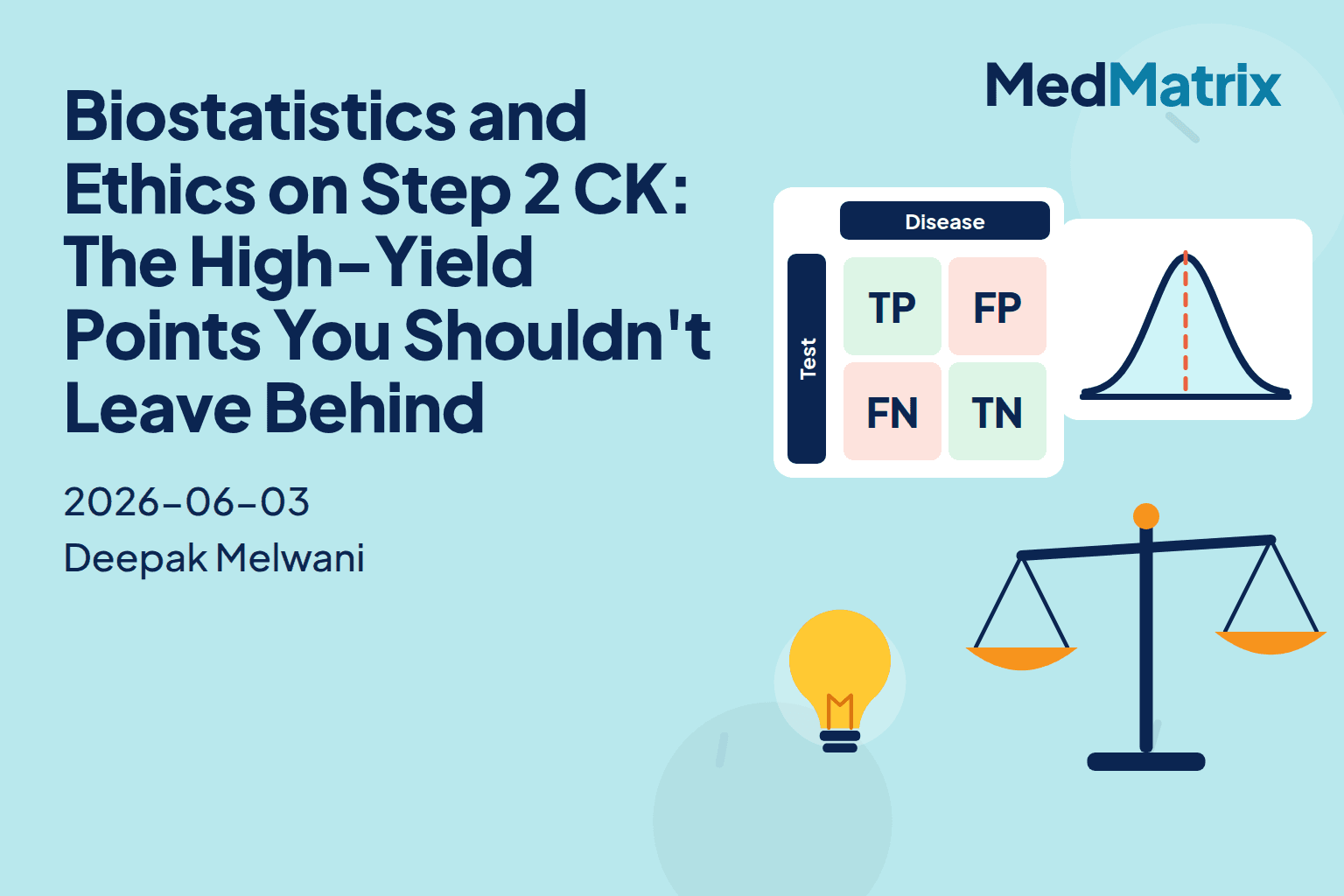
The 2×2 Table
Nearly every diagnostic test question comes back to this table:
| Disease present | Disease absent | |
|---|---|---|
| Test positive | True positive (TP) | False positive (FP) |
| Test negative | False negative (FN) | True negative (TN) |
- Sensitivity = TP / (TP + FN): the proportion of people with the disease who test positive
- Specificity = TN / (TN + FP): the proportion of people without the disease who test negative
- Positive predictive value (PPV) = TP / (TP + FP): the chance that a positive result is a true positive
- Negative predictive value (NPV) = TN / (TN + FN): the chance that a negative result is a true negative
Two ideas come up again and again:
- SnNOut and SpPIn. A highly sensitive test, when negative, helps rule a disease out. A highly specific test, when positive, helps rule it in.
- Prevalence changes predictive values, not sensitivity or specificity. As prevalence rises, PPV rises and NPV falls.
A quick worked example: A test with 90% sensitivity and 80% specificity is used in 1,000 people, 100 of whom have the disease. It finds 90 true positives and 10 false negatives. Among the 900 people without the disease, it produces 720 true negatives and 180 false positives. The PPV is 90 / (90 + 180), or about 33%, while the NPV is 720 / (720 + 10), or about 99%. A good test in a low-prevalence population still produces many false positives.
Risk and Treatment Effects
- Relative risk (RR) compares the risk of an outcome in exposed vs. unexposed groups. It's used in cohort studies.
- Odds ratio (OR) = (a × d) / (b × c). It's used in case-control studies.
- Absolute risk reduction (ARR) = control event rate − experimental event rate
- Relative risk reduction (RRR) = ARR / control event rate
- Number needed to treat (NNT) = 1 / ARR
- Number needed to harm (NNH) = 1 / absolute risk increase
For example, if 10% of patients in the control group have a stroke and 6% in the treatment group do, the ARR is 4%, the RRR is 40%, and the NNT is 1 / 0.04 = 25.
Study Design, Error, and Bias
- Study designs: Know when a question describes a randomized controlled trial, a prospective or retrospective cohort study, a case-control study, or a cross-sectional study.
- Type I error (α): concluding there's an effect when there isn't one (a false positive).
- Type II error (β): missing a real effect (a false negative). Power = 1 − β, and it increases with larger sample sizes.
- Confidence intervals: For a ratio like RR or OR, an interval that includes 1 isn't statistically significant. For a difference between groups, an interval that includes 0 isn't significant.
- Classic biases: selection bias, recall bias, confounding, the Hawthorne effect, lead-time bias (earlier detection makes survival look longer without changing outcomes), and length-time bias (screening preferentially detects slower-growing disease).
Ethics and Communication: Principles That Predict the Answer
Ethics questions reward consistent principles. The right answer usually respects patient autonomy, protects patients from harm, and keeps communication honest and direct.
Informed consent:
- Requires disclosure of the diagnosis, the proposed intervention, its risks and benefits, and the alternatives, including no treatment. The decision must be voluntary and made by a patient with decision-making capacity.
- In a true emergency, when a patient can't consent and no surrogate is available, treatment proceeds under implied consent.
Decision-making capacity:
- Capacity is a clinical determination made by physicians and is specific to the decision at hand. Competence, by contrast, is a legal determination made by a court.
Surrogate decision-making:
- When a patient lacks capacity, look first to their own previously expressed wishes, such as an advance directive or a designated health care proxy. Otherwise, a surrogate is identified according to state law, often a spouse, then adult children, then parents.
Minors:
- Parental consent is generally required, but many states allow minors to consent to certain care, such as contraception, STI testing and treatment, prenatal care, and substance use treatment. Emancipated minors can consent for themselves.
Confidentiality and its limits:
- Confidentiality can be broken when a patient poses a serious threat to an identifiable person, for reportable infectious diseases, and for suspected child abuse. Many states also require reporting of elder abuse.
Honesty and communication:
- Disclose medical errors to patients, even when no harm resulted.
- Use a professional medical interpreter rather than a family member.
- When a patient requests an unnecessary test or medication, explore their concerns and educate rather than simply refusing or complying.
- An adult patient with capacity can refuse treatment, including life-sustaining treatment and blood products.
Patient Safety: Think in Systems
Patient safety questions usually favor system-level fixes over blaming individuals:
- Root cause analysis looks for the underlying system failures behind an adverse event.
- The Swiss cheese model describes how errors pass through multiple layers of defense when their weaknesses line up.
- Standardized handoffs and checklists reduce communication errors.
- Near misses should be reported, because they reveal weaknesses before anyone is harmed.
How MedMatrix Helps You Lock In These Points
- Targeted question sets: Build Step 2 CK practice tests on biostatistics, ethics, and patient safety from MedMatrix Standardized Content, with an explanation for every answer.
- Practice the new rhythm: Create 20-question timed tests in Testing mode to mirror the new 30-minute blocks.
- Formulas that stick: Generate flashcards for each formula and definition, and let spaced repetition bring them back just before you'd forget them.
- Work the 2×2 table step by step: Use the AI Tutor's Guided Learning mode to walk through a sensitivity, PPV, or NNT problem one step at a time until the process becomes automatic.
Biostatistics and ethics aren't the most glamorous parts of Step 2 CK, but they may be the most dependable. Learn the formulas, practice the 2×2 table until it's second nature, and apply the same ethical principles every time. Those points are there for the taking.